NCC-1701 started with a simple idea, if we want to explore what comes after today’s AI, we also need a name that looks beyond it.
NCC stands for Novel Cognitive Computing.
It describes our field of interest, new ways of building machines that can reason, learn, understand systems and work with the real world. Not larger language models, but different ideas about computing and intelligence altogether.
1701 has two meanings.
It is a reference to Gottfried Wilhelm Leibniz, one of the early thinkers behind binary computation in 1701 and the idea that reasoning itself could become something we calculate. His famous idea was simple – Calculemus. Let us calculate.
And, of course, NCC-1701 is also the registration number of the USS Enterprise. A ship built for exploration, not for staying safely where everyone has already been.
That combination became the identity of NCC-1701
Novel Cognitive Computing.
Exploring what comes after today’s AI.
To boldly go beyond today’s AI.
We are an applied AI research lab
The researchers within NCC-1701 have spent decades working on large-scale transformation programs involving operations, software delivery, governance, process optimization, and organizational redesign. We understand that AI adoption rarely fails because of model quality but because of fragmented processes, weak ownership, unclear accountability, poor measurement, and the inability to turn experiments into repeatable operating capability.
Our work is organized around two pillars. The first is process agentification, redesigning enterprise processes so that AI agents, workflows, human oversight, and control mechanisms operate as one coordinated system. The second is AI-assisted software development lifecycles, where engineering itself is transformed through AI-enabled architecture, coding, testing, deployment, and continuous improvement. In both areas, we work from strategy through execution to measurement of business outcomes.
Frontier AI and Enterprise AI Are Not the Same Thing
The frontier laboratories are building remarkable systems. Trillion-parameter architectures, hyperscale compute, world models, increasingly sophisticated reasoning. We respect that work. And it will continue to shape the future of computing.
But frontier AI and enterprise AI solve different problems. Frontier systems are optimized for raw capability and benchmark performance whereas enterprises need AI that can be planned, predicted, audited, governed, and economically justified. They need systems that function consistently in regulated environments, within established workflows, and under conditions where mistakes carry financial, legal, or reputational consequences.
That is why we use the term Blue AI. It is our name for enterprise-grade intelligence engineered for reliability, accountability, and measurable value creation. AI designed not to impress, but to perform.
The NCC-1701-AI Research Program
To advance this vision, we launched our own research initiative, the NCC-1701-AI program, also known as the Blue AI Program. Its purpose is to develop an AI system that is capable of operating safely and effectively in the parts of the enterprise where current approaches are least trustworthy and where the greatest value is at stake.
The program began with a detailed analysis of 177 agentic automation projects across multiple domains. The findings were consistent. Current AI performs well in narrow task environments, but degrades sharply when introduced into complex operational processes involving exceptions, dependencies, controls, and cross-functional accountability.
This led us to develop the Process Zone Model.
The four process zones
We classify enterprise work into four zones. Zone I covers isolated, low-risk tasks with limited consequences: summarization, drafting, retrieval, categorization. Current AI handles this well. Zone II includes structured workflows with clear decision points and human supervision, such as service operations, intake flows, and document handling. Current AI can perform here with the right orchestration. Zone III is where most strategic enterprise value lives: complex, exception-heavy, compliance-sensitive, cross-functional processes including finance operations, legal approvals, healthcare pathways, procurement controls, and mission-critical service delivery. These processes are dynamic, interconnected, and sensitive to error.
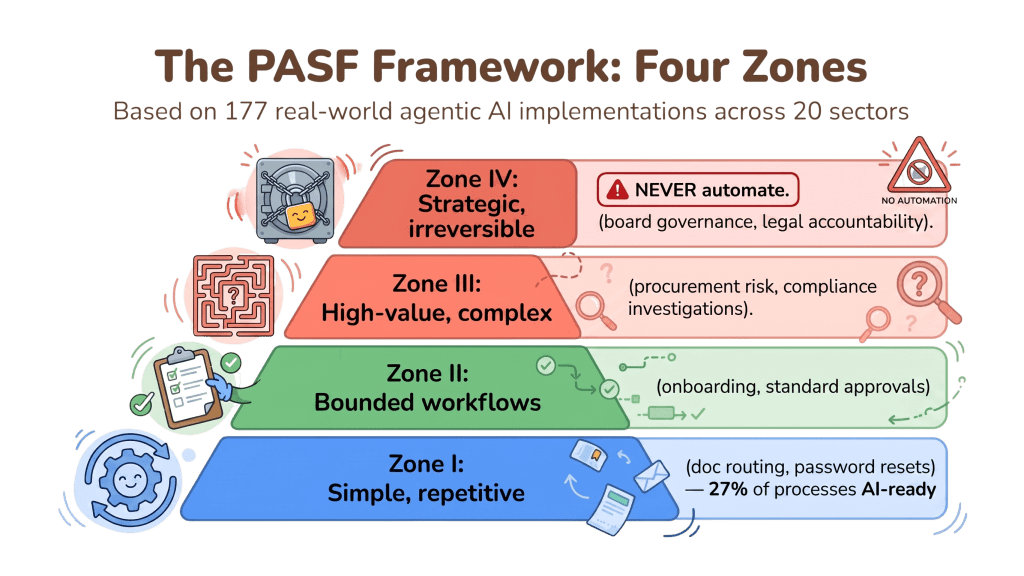
Zone III is also where most current AI becomes unreliable.
Zone IV covers fully autonomous, self-optimizing operations where AI systems coordinate, adapt, and govern themselves across the enterprise without continuous human intervention. No current AI system operates reliably at this level. It is the frontier we are building toward.
The agentification ceiling
Based on our research, current mainstream AI architectures face what we call the agentification ceiling, which today sits at approximately 35 percent. Only a minority of enterprise processes can be safely automated using current task-oriented AI systems.
The reason is structural. Most models are trained to perform tasks, not to understand processes. They do not naturally reason across long operational chains, conflicting constraints, governance obligations, and downstream consequences.
Deploying unconstrained AI into Zone III operations means introducing probabilistic behavior into deterministic environments. Errors may be infrequent, but when they occur they are expensive, invisible, and difficult to trace.
Neurosymbolic AI and the ontological compliance gateway
The objective of the Blue AI Program is to build AI capable of operating inside Zone III with trustworthiness and control. To achieve this, our systems combine modern machine learning with symbolic reasoning. Neural models are strong at pattern recognition, language understanding, and probabilistic inference. Symbolic systems are strong at logic, structure, constraints, and explicit reasoning. Neural systems generate possibilities. Symbolic systems govern what is permissible. Together, they create AI that is both capable and disciplined.
At the center of our architecture is the Ontological Compliance Gateway. The OCG acts as a control layer between model outputs and enterprise execution. A semantic gate interprets meaning, relationships, domain entities, and business intent. A rules gate applies formal constraints including compliance policies, approval hierarchies, thresholds, segregation of duties, and legal restrictions. Together, they ensure that AI decisions are not merely plausible, but contextually valid and operationally allowed.
Governance by design
In most AI deployments, governance is an afterthought. Controls are added later, dashboards are built later, and auditability surfaces only after the first audit request. We reject that model. In Blue AI, governance is built directly into the runtime architecture. Traceability, explainability, control logic, and policy enforcement exist from day one. The result is a system with built-in discipline rather than one that requires constant correction after failure.
The next era of AI will not belong only to those who build the largest models. It will belong to those who build the most trusted systems.


